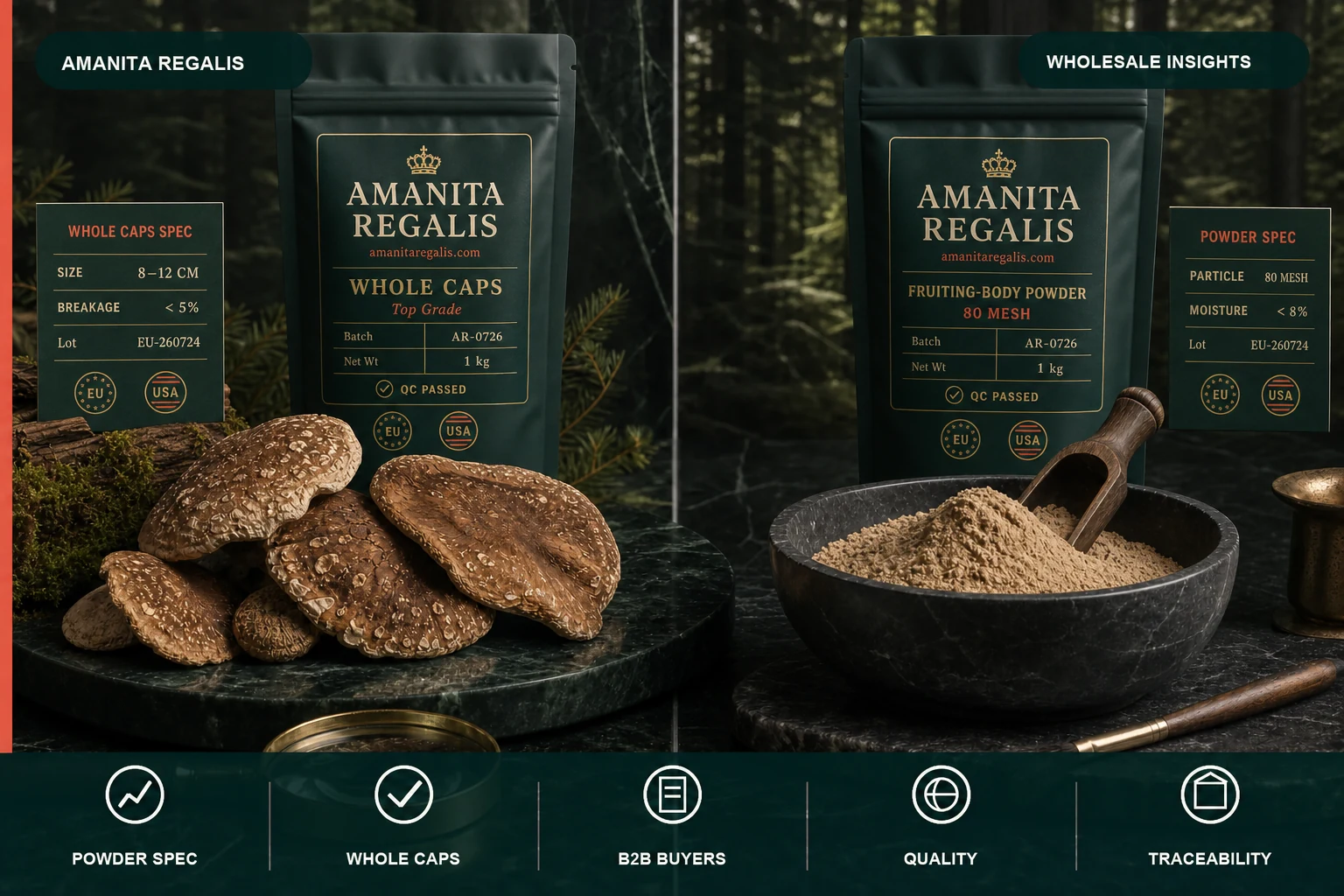
Whole caps and powder can originate from the same species but serve different business models. The choice affects how the material is approved, stored, handled and presented to customers.
Buyers should compare operational fit before comparing price per kilogram.
Whole caps make appearance part of the product
Whole caps support visual grading and allow customers to see the natural material. This format often requires tighter sorting, protective packing and clearer rules for natural variation.
Representative images and a physical sample are valuable when appearance contributes to the commercial offer.
Powder shifts attention to processing behaviour
Powder is easier to portion and integrate into further manufacturing. Important questions include particle size, density, packaging and protection from moisture.
A buyer using filling or blending equipment should validate how the proposed powder behaves in the intended workflow.
Specifications should not be interchangeable
A whole-cap specification focuses on presentation and breakage, while a powder specification focuses on identity, grind and handling characteristics.
Create separate approval criteria even when both formats will be purchased from the same supplier.
Inventory profiles are different
Whole caps may occupy more warehouse volume and require careful stacking. Powder can be compact but may need smaller sealed inner units to reduce repeated opening.
Estimate normal consumption and choose pack sizes that fit actual warehouse and production activity.
A two-format range can serve different buyers
Some distributors carry both formats so they can serve specialist retail and manufacturing customers. This works best when demand justifies the added stock-keeping complexity.
Begin with the strongest channel and add a second format after the first purchasing and delivery process is stable.